

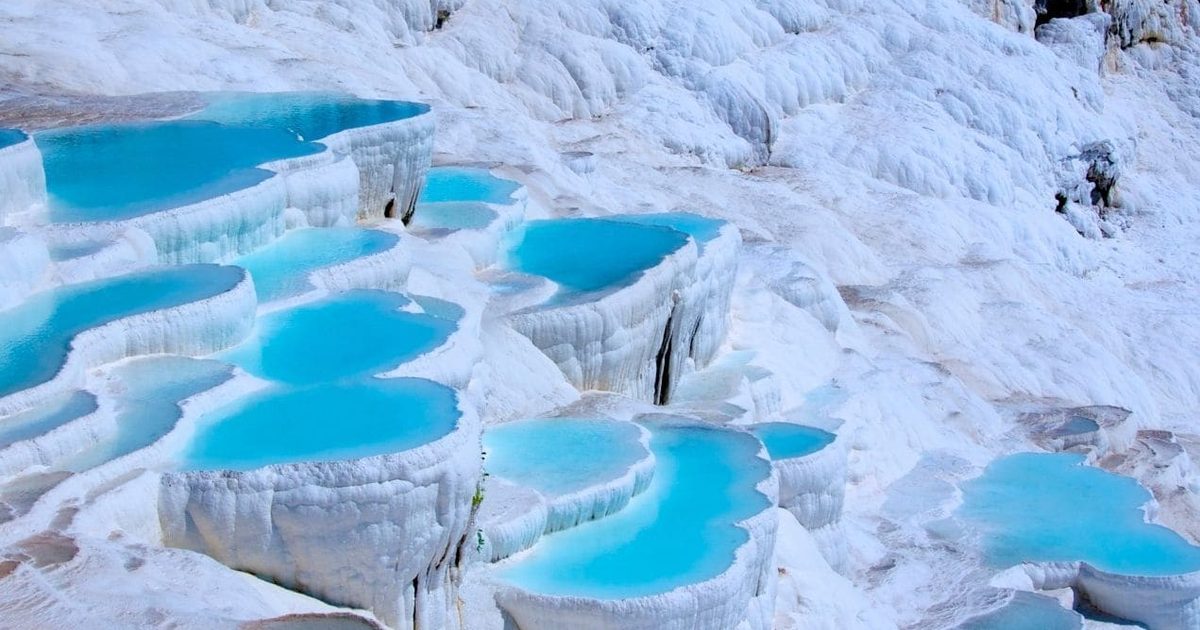
The first thing almost everyone says when they see Pamukkale is that it looks like snow. It isn't, of course. What you're looking at is a whole hillside of white limestone, laid down drop by drop by warm spring water over thousands of years. Then you take your shoes off, step onto it, and find that it's warm under your feet. That's usually the moment people stop taking photos and just stand there for a second.
We plan Pamukkale visits for travellers all year round, mostly as part of an Ephesus trip, and one pattern keeps repeating: the people who love it most are the ones who knew a few practical things before they arrived. Which gate to start from. That the turquoise pools aren't for swimming. That the ancient city on top deserves at least as much time as the terraces. This guide is what we'd tell you over a coffee before you go.
What Makes Pamukkale Special
Pamukkale means "cotton castle" in Turkish, and from the road below you can see why. The white terraces, called travertines, form when calcium-rich thermal water flows over the slope, cools, and leaves a thin layer of mineral behind. Repeat that for a few thousand years and you get shelves, basins and frozen-looking waterfalls of stone.
Here's the part many visitors miss: the terraces are only half the site. On the plateau above them sits Hierapolis, a Greco-Roman spa city founded in the 2nd century BC. People travelled here in antiquity for exactly the same reason you will: the warm water. Baths, temples, a huge theatre and one of the largest cemeteries in Anatolia grew up around it. Together, the terraces and the ruins were listed as a UNESCO World Heritage Site in 1988.
So don't treat Pamukkale as a quick photo stop. It's a natural wonder and an ancient city on the same hill, and the best visits give each one proper time.
Rules on the Travertines (and Why They Exist)

The rules can feel strict at first. They make more sense once you know why they're there.
- Shoes come off. All of them, including sandals and water shoes. The travertine is softer than it looks, and soles scratch and stain it. Carry your shoes in a small bag.
- Watch your footing. Where it's dry, the surface feels a bit like a coarse nail file. Where water runs over it, it can be as slippery as wet soap. Small steps, especially going downhill.
- Stay on the marked path. Most of the hillside is closed off so it can stay white, and the guards will whistle if you wander. Keep to the path and you'll have no trouble.
- No swimming in the terrace pools. Wading along the open path is part of the experience. Swimming happens in one place only, the Antique Pool, which has its own ticket.
- The pools change. The water is channelled to different sections over time so the stone can rest and recover. Some days there are more turquoise pools along the path than others. That's normal, and it's the reason the terraces still look the way they do.
Rules and access can change, so check on the day with your guide or at the site.
The Antique (Cleopatra) Pool

At the top of the hill, inside Hierapolis, there's a thermal pool where you swim among ancient marble. Columns and carved blocks, knocked down by an earthquake long ago, lie on the bottom under clear, warm water. The water sits at roughly body temperature all year, so a swim feels just as good in November as it does in May.
You'll hear it called the Cleopatra Pool. That's a name for visitors. There's no evidence that Cleopatra ever swam here, though it's easy to see why the story stuck.
A few practical points:
- The pool has its own entrance fee, separate from the main site ticket. If you're on a tour, ask whether it's included.
- Bring swimwear and a quick-dry towel. There are changing rooms and lockers on site.
- It gets busy around midday when day-trip groups arrive. Early morning or late afternoon is calmer.
Exploring Hierapolis
Give the ancient city real time. Two hours is a good minimum if you want to see more than the main path.
The Roman Theatre

The theatre is a short, steep walk uphill from the pool, and in summer you'll feel every step. It's worth it. The rows of stone seats climb the slope, and a large part of the decorated stage building is still standing, with carved reliefs you can make out up close. Sit near the top for a moment. The view across the valley is one of the best on the whole site, and it's usually far quieter than the terraces below. If you're doing things on foot, go up early while your legs are fresh.
The Plutonium and the Necropolis
Next to the Temple of Apollo is the Plutonium, a small cave-like opening that ancient people believed was a gateway to the underworld. Writers of the time described birds dropping dead as they flew near it, while priests walked in and came out unharmed. The explanation turned out to be geology. Volcanic carbon dioxide seeps out of the ground here. Modern measurements found the gas collects close to the floor at levels deadly to small animals, especially in the early morning. A tall priest standing upright would have been breathing much cleaner air.
Outside the city walls, the necropolis runs along the old road for a long way: rock-cut tombs, house-shaped tombs, round burial mounds and stone sarcophagi, many with their lids pushed aside. It's one of the largest ancient cemeteries in Anatolia, and walking through it in the late afternoon light is one of the most atmospheric parts of a visit. If you enter from the North Gate, you'll walk right through it.
Early Christian Heritage
Christian tradition holds that the Apostle Philip was martyred at Hierapolis. On the hill above the city stands the Martyrium of St Philip, an unusual eight-sided building raised in his memory. In 2011, Italian archaeologists working at the site announced that they had found a tomb nearby that they believe belongs to Philip. For travellers interested in the early church, this pairs naturally with Ephesus. Our guide to biblical sites in Turkey covers the wider route.
Which Gate Should You Use?

Pamukkale has three entrances, and the one you choose shapes your whole visit.
- South Gate: The best option for a full visit on your own. You start among the main ruins, see Hierapolis and the Antique Pool, then walk out onto the travertines and make your way down the white slope towards the village.
- North Gate: Close to the necropolis and popular with tour coaches. Your walk to the terraces takes you along the avenue of tombs, which is a great way to arrive.
- Town Gate (village side): At the foot of the terraces in Pamukkale village. You walk up the white hillside barefoot from the bottom. It's a beautiful approach, but it's uphill and tiring in the heat, so save it for early morning, late afternoon or a cooler season.
Our honest advice: if you're independent, start at the South Gate and finish at the bottom. Walking down the terraces is easier on your legs and keeps the view in front of you the whole way. On organised tours, the guide picks the gate based on the route and the time of day.
How Pamukkale Fits with Ephesus and Istanbul
Pamukkale is inland, in the hills of south-western Türkiye. Ephesus is on the Aegean coast, about three hours away by road. That distance is the reason most travellers combine the two.
Istanbul is much further. Most visitors fly to İzmir and continue by road, or fly into Denizli, the nearest city, which has its own airport with domestic flights about an hour's drive from the terraces. Flight schedules change by season, so ask us for current options when you plan.
| Option | Best for | Good to know |
|---|---|---|
| Day trip | Short stays on the coast | A long day, with roughly three hours of driving each way |
| One night in Pamukkale | Seeing Ephesus and Pamukkale without rushing | You get the terraces in evening and morning light |
| Multi-city tour | Istanbul, Cappadocia and the Aegean together | Domestic flights link the regions |
How we'd plan it:
- Staying in Antalya or İzmir? A Pamukkale day trip covers the terraces and Hierapolis in one long, full day.
- Want Ephesus too? The 2-Day Ephesus & Pamukkale Overnight Tour does Ephesus on day one and Pamukkale on day two, with a night in between. Read our Ephesus travel guide before you go.
- Starting in Istanbul? The 7-Day Ephesus & Pamukkale Tour with Istanbul gives you the city first, then the Aegean.
- Want all three regions? The 9-Day Turkey Tour with Cappadocia & Pamukkale brings Istanbul, Cappadocia and the Aegean together. Our 10-day Turkey itinerary shows how the pieces fit.

Best Seasons and What to Bring
Spring (April to June) and autumn (September to November) are the most comfortable months. The air is mild, the light is soft, and walking around the ruins is a pleasure rather than a test.
Summer is very hot. There's almost no shade on the terraces or across Hierapolis, and the white stone reflects the sun straight back at you. If you're coming in July or August, go early and keep the middle of the day for a long lunch.
Winter is quiet and cool, and it has its own magic. On cold mornings, steam rises off the warm pools and drifts across the white slope. Bring a warm layer, especially for the evening.
What to pack:
- Shoes that slip on and off easily (you'll take them off and put them back on more than once)
- A small bag for your shoes
- Swimwear and a quick-dry towel for the Antique Pool
- A hat, sunglasses and sunscreen, even outside summer, because the white stone is bright
- Plenty of water
How to Avoid the Crowds
The terraces are at their busiest from late morning to mid-afternoon, when coaches arrive from the coast. Two simple ways around it:
- Go early. The first hour after opening is cool, quiet and gives you clean photos without people in every shot.
- Stay late. In the late afternoon the crowds thin out, and as the sun drops the white stone turns soft gold and then pink. Many travellers say this was their favourite moment of the whole trip.
Staying one night in Pamukkale lets you do both. And if the terraces feel busy, head up to the theatre or out to the necropolis. Those areas are calm at almost any time of day.
What the Photos Don't Show You
We'd rather you arrive with the right picture in mind. The famous photos of brimming turquoise pools are usually taken in the best light, from the best angle, on the best day. In reality, parts of the hillside will be dry and resting, and the visitor path covers only a section of the terraces. Some people are surprised by that.
What the photos also don't show is how it feels: warm water running over your feet, the view stretching across the valley, a Roman theatre almost to yourself an hour later, and a swim among ancient columns. Go with realistic expectations and give Hierapolis the time it deserves, and Pamukkale rarely disappoints.
Frequently Asked Questions
Do I need to take my shoes off?
Yes. Shoes aren't allowed on the white terraces, so you walk barefoot. Bring a small bag to carry them.
Can I swim in Pamukkale?
Yes, in the Antique (Cleopatra) Pool, which has a separate ticket. Swimming in the travertine pools isn't allowed, but you can wade where the path runs through the water.
How long do I need in Pamukkale?
At least half a day to see the terraces and Hierapolis properly. A full day, or an overnight stay, is much more relaxed and lets you see the site in both morning and evening light.
Is the barefoot walk difficult?
The path is not technical, but it is barefoot, uneven in places and slippery where water flows. Most people manage fine by taking it slowly. If walking is hard for you, entering from the top lets you see the terraces and the ruins without walking the whole slope.
Is Pamukkale worth visiting with Ephesus?
Absolutely. Ephesus shows you a great Roman port city; Pamukkale gives you a Roman spa town on top of a natural wonder. They complement each other well, and most travellers combine them over two days.
Ready to see Pamukkale?
Book the 2-Day Ephesus & Pamukkale Overnight Tour, or tell us your dates and we'll put together a tailored plan.
